Let’s start with some fundamental political positions: 1948 was the moment when Israeli Jews took up the right to national self-determination on territory already occupied by Palestinian Arabs, and 1948 (the Nakba) was the moment when Palestinian Arabs were denied their right to national self-determination on the same territory; the Israeli state and military occupation of Gaza and the West Bank since June 1967 must end to enable the realisation of a fully autonomous Palestinian nation-state alongside Israel; the atrocity committed by Hamas on 7th October 2023 should be condemned and opposed; the war in Gaza by the far right coalition government of Netanyahu, along with the settler crimes against Palestinians in the West Bank, since 7th October 2023, are an atrocity and must be condemned and opposed. These positions do not align with much of the activist and academic left, who hold different fundamental political stances: ‘justice for the Palestinians’ equates to a political demand to fully undo the nation-state of Israel on 1948 borders; the Hamas murder and kidnapping of civilians on 7th October 2023 is seen as the reality of ‘decolonisation is not a metaphor’, i.e., a necessary resistance against the greater Evil of Israel; and, the idea that ‘atrocities’ happen on ‘both sides’ is regarded as a mischievous attempt to make symmetrical an asymmetrical conflict between two incommensurable sides. Here, Zionism is an extreme exemplar of colonialism, imperialism and racism; and, Islamist Hamas is the anti-racist resistance worthy of unconditional support.
For many on the Left, unless someone is a Jew who vocally calls for the liberation of Palestine ‘from the river to the sea’ and thus for the destruction of Israel in its entirety, then that person is not an acceptable Jew. The Left has its high-profile acceptable, assimilated and enlightened ‘Jews’ – from the late Tony Cliff (founder of the Socialist Workers’ Party) to Ilan Pappé – who are showcased to demonstrate the apparent absurdity of the claim that anti-Jewish racism exists on the Left.
In the immediate aftermath of 9/11, it was commonsense, instinct even, for the Left to oppose the individual and collective racist scapegoating of Muslim-identifying people. And yet, what seems obvious in one dynamic of social relations simply isn’t seen as obvious in a comparable one: it is always racist to single out a person or a group on the basis of their negatively racialised ethnicity. Enter the Climbers for Palestine Instagram rant against Guy Mor, the founder of activewear brand, Third Rock, and the call for a boycott: “climbers! if you’re buying from Third Rock, you’re buying from Zionists”.
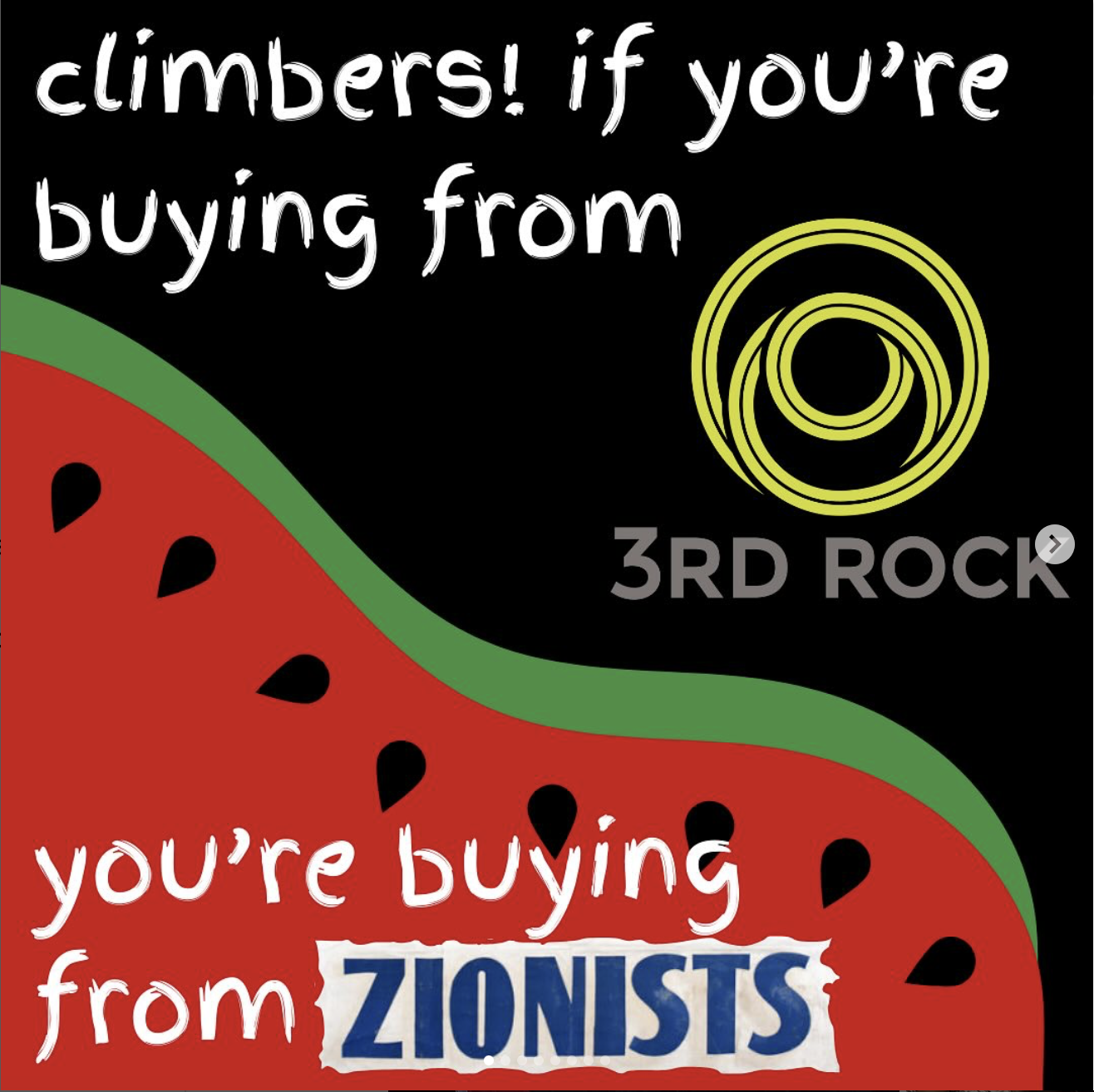


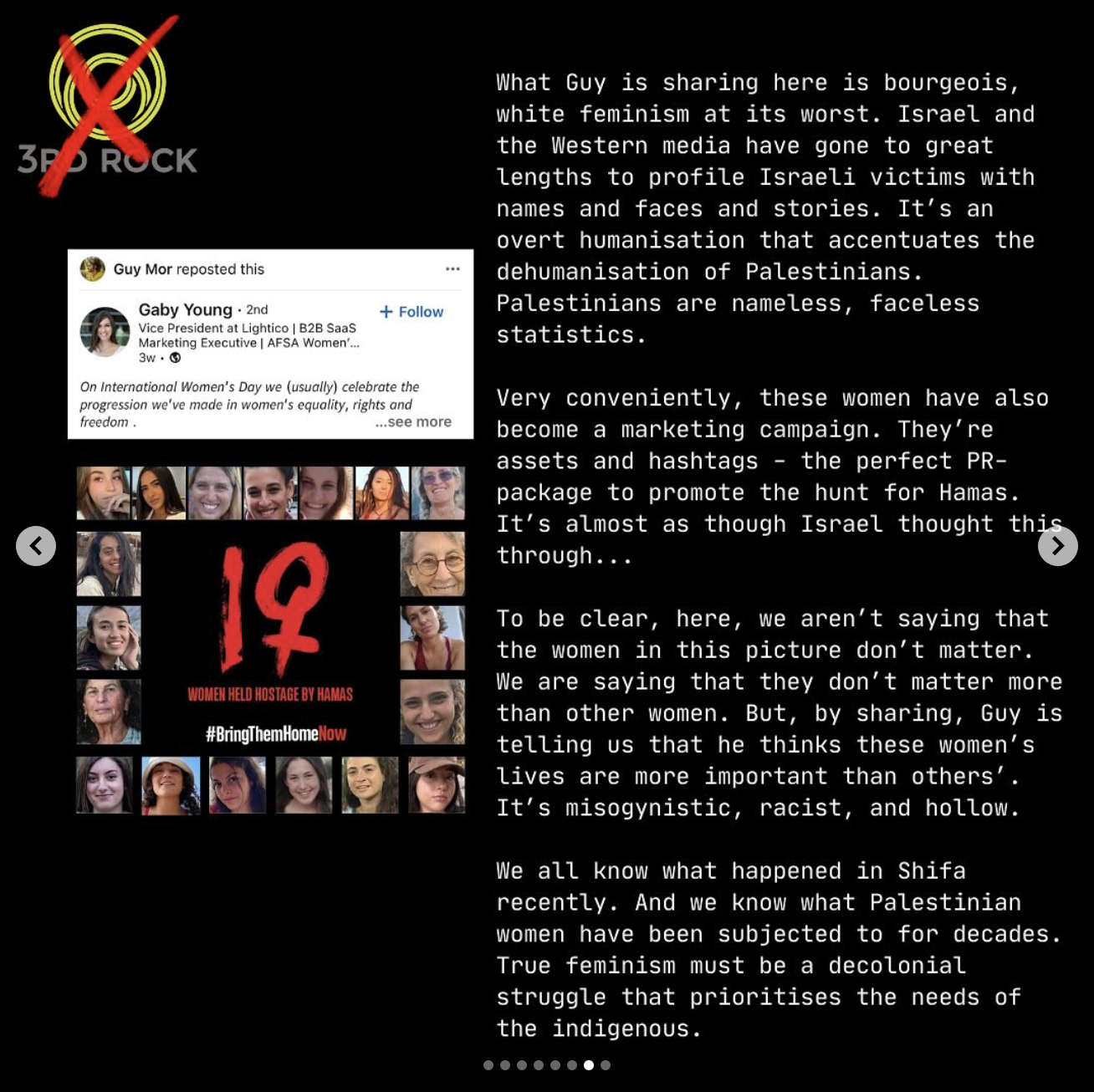
Speaking in the Jewish Chronicle, Guy Mor states in relation to the reaction to this post:
“They called me a Zionist genocide denier, a bloodthirsty baby killer, that I was a member of the ‘IOF’, the ‘Israeli occupation force’. […] I just wrote a couple of respectful comments, and they took them out of context. I never said I support genocide. I think there should be a ceasefire as soon as possible, and my view is that the way to get there is to release the hostages. […] I was called a ‘bloodthirsty baby killer’, ‘ignorant’ and [was told] ‘I know nothing about the conflict (me, who was born in Israel, worked with Palestinians in the West Bank and was a political “left” [supporter] advocating for Palestinian rights). […] I do believe that Palestinians have a right to a state and I do think there are a lot of wrongdoings by Israel in the West Bank…I personally have probably done more to promote the Palestinian cause than a lot of [members of the Climbers for Palestine group]. […] Some [Instagram users] have posted stories about how they can’t be associated with a brand that supports genocide or the suffering of Palestinians. But 3rd Rock has always been about inclusivity and supporting minorities.”
A discussion could be had on the rights and wrongs of Guy Mor’s publicly profiled politics, but the act of singling out an individual on the basis that they are Jewish or Israeli to assess the rights and wrongs of their politics is itself problematic. Engaging and debating with people as people about the rights and wrongs of their politics is not problematic. Most Jews around the world have an affiliation (within the historical context of the Holocaust) with Israel and thus with Jewish nationalism or Zionism. What all leftists could do, vis-a-vis Israel-Palestine, is engage in discussion with all people who come into our orbit – including people who identify as Jewish and as Muslim.
‘Here is a Muslim and here is what is wrong with this Muslim, but (by the way) I’m not a racist as some of my best friends are Muslims’ is an unheard of phenomenon on the Left; however, ‘here is a Jew and here is what is wrong with this Jew, but (by the way) I’m not antisemitic as some of my best friends are Jews’ is not. ‘Race’ is not real, it is socially imagined and that social imaginary is real with real-world consequences. In the history of ‘race’ and racism, both ‘Jews’ and ‘Muslims’ have been negatively racialised and, in our contemporary world, anti-Jewish racism and anti-Muslim racism are bound up with Israel-Palestine. The singling out of a man called Guy Mor and his clothing brand Third Rock is one example of this. Whoever Climbers for Palestine is had a democratic right to engage and debate with Guy Mor on the rights and wrongs of his politics and vice versa, but a dangerous line was crossed in doing so on the basis of the negative racialisation of ‘Jews as racist Zionists’.
It’s worth ending with the political question of boycotts in this context, which is addressed well by Ira Berkovic from Workers’ Liberty:
“Cutting ties with any and all Israeli organisations, invariably translated by many into cutting ties with any and all Israelis, even those actively campaigning against war and occupation, and then maybe shunning Jews who feel some critical empathy with Israelis, will not help stop the war. Instead, deeper ties of solidarity with Israeli peace movements, to help them grow their struggles, are needed. Placing demands on our own governments to undertake specific forms of “sanction” against Israel, such as the withdrawal of arms sales licences, is a vital focus for anti-war activity. But external pressure alone will not transform Israeli society. The toppling of South African apartheid provides a salient historical lesson here. Campaigns of boycott and economic isolation were pursued against the apartheid state for decades, without threatening its political foundations. Those foundations were most meaningfully shaken when black workers, on whose labour the apartheid system relied, rose up in strikes and mass action. The 20% Palestinian minority within Israel is overwhelmingly part of the country’s working class. Despite facing significant racism and repression, it has a greater ability to assert itself politically than the bombarded and occupied populations of Gaza and the West Bank. A movement that unites those workers with at least a substantial part of the (much larger) Jewish working class, on the exploitation of whose labour the Israeli economy primarily depends, could have a radically transformative effect. Building such a movement requires winning those workers to a perspective based on equality. We can contribute most to progressive change on the ground by providing political support and practical solidarity to activists undertaking those efforts.”
 Anaemic On A Bike