

Pankaj Mishra’s (2024) essay in the London Review of Books, “The Shoah after Gaza”, is essentially a call for ‘ordinary Jews’ to become ‘exceptional Jews’: to learn the correct lesson from the Holocaust, which is to become extraordinary human beings. The problem, for Mishra, is that most Jews, inside Israel and beyond, are ‘ordinary Jews’ and thus are bad, immoral and complicit in Netanyahu’s (and his far-right coalition government’s) brutal war in Gaza and settler violence in the West Bank. In his essay, Mishra highlights the standalone ‘ordinary Jews’ who transformed themselves into ‘exceptional Jews’. He also explains how the State of Israel weaponises the Shoah to inflict harm on the Palestinians and to claim immunity from criticism at its own Nazification. When Palestinians resist Israel, they are denounced as Nazis, when, in actual fact, Mishra argues, it is Israel that embodies Nazism. “Never before have so many witnessed an industrial-scale slaughter in real time”, he states. Such is the unprecedented barbarity of Israel.
Mishra’s essay pivots on the following claim:
“Popular West-is-best accounts of totalitarianism continue to ignore the acute descriptions of Nazism (by Jawaharlal Nehru and Aimé Césaire, among other imperial subjects) as the radical ‘twin’ of Western imperialism; they shy away from exploring the obvious connection between the imperial slaughter of natives in the colonies and the genocidal terrors perpetrated against Jews inside Europe.”
The problem here is that the Holocaust cannot be reduced (and subsequently banished) to a ‘colonial model of racism’ and a related ‘imperial boomerang thesis’, which severs antisemitism from its long and deep pre-history and history as racism and de-historicises the formation of the nation-state of Israel. Moreover, the horrors of the Holocaust should not be neatly equated (and neutralised) to the horrors of Western colonialism, because, by doing so, we fail to comprehend what was previously unknown in Nazi totalitarianism: the descent from everything is permitted into everything is possible.
In the context of conceptually and empirically deflating the Holocaust to a mirror or boomerang of an older Western imperialism, Mishra presents Israel-Palestine as a colour-based colonial struggle: white colonial bodies oppressing and slaughtering black and brown natives while instrumentalising the Shoah to shield criticism of its own Shoah-like terror. Mishra understands antisemitism as a fabricated weapon against the enemies of Israel and a real product of Israeli terror. Either way, he argues, Jews themselves, by being ‘ordinary Jews’, degrade the history of the Shoah and inflict self-harm.
Of course, the right-wing weaponisation of antisemitism is a reality, but so too is antisemitism. And blaming the Jewish collective for the surge in antisemitism since the Israeli state’s war in Gaza is as ludicrous as blaming the Muslim collective for the surge in anti-Muslim racism after 9/11. As leftists, we should aspire for all people to become extraordinary human beings on the basis of their human condition, not on the basis of their identity (as Jewish).
Since the last report of “Peoples under Threat 2021” from Minority Rights Group, one can sadly assume that Occupied Palestine would now feature in this table below. But Mishra is wrong to state that we have never before witnessed an industrial-scale slaughter in real time, given (for example) Assad’s war on his own population in Syria from 2011 to date.
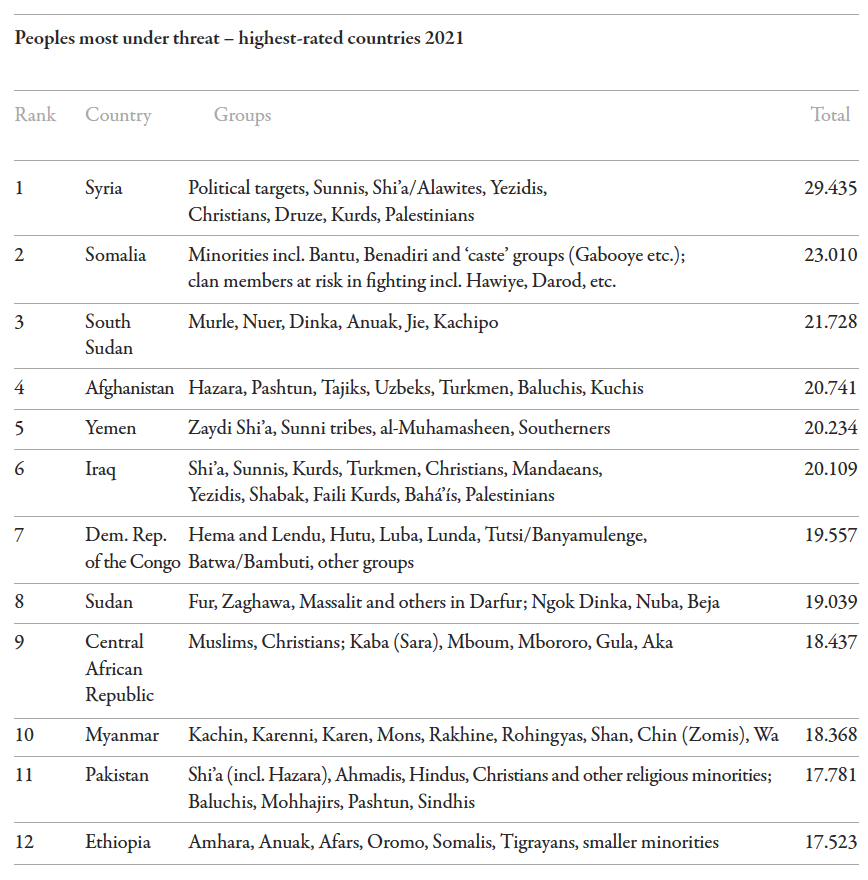
What does Mishra hope to achieve by his essay? Is it an effort towards growing the anti-war movement in Israel? Is it a call for the immediate alleviation of Palestinian suffering and for longer term justice for the Palestinians in the form of a nation-state alongside Israel on pre-1967 borders? It is neither. Mishra writes a consciously moral essay aimed at shaming Jews (most Jews) and praising the odd exceptional Jews. “Many of us”, Mishra remarks, “who have seen some of the images and videos coming out of Gaza – those visions from hell of corpses twisted together and buried in mass graves, the smaller corpses held by grieving parents, or laid on the ground in neat rows – have been quietly going mad over the last few months.” The visceral affect of this recent war in Gaza might be worth reflecting on, but by obsessing with ‘the Jewish question’ Mishra does nothing to progress the plight of the Palestinians.
[Featured image from Wikimedia Commons: “Gaza war damage 2023”, Tasnim News Agency]
 Anaemic On A Bike