
I teach a final year module on Globalisation. This past year, in the last session of this module, one of my most engaged students challenged my dismissal of conspiracy theories. He drew a similarity between the academic critique of power, hegemony, capitalism, and globalisation and the purpose of conspiracy theories to not accept reality but to push beneath the surface to find the truth to power, hegemony, capitalism, and globalisation. I found myself intellectually pushed to explain the vital difference between our job as academics to question everything and the tendency of conspiracy theories to, well, question everything.
Bruno Latour’s (2003) essay – Why Has Critique Run out of Steam? From Matters of Fact to Matters of Concern (extracts of which I include below) – is incredibly helpful. As critical academics, Latour reminds us, we move closer to facts, not away from them, in a renewed empiricism; we assemble, we don’t debunk. This resonates with Mark Fenster’s observation of the contrasting conspiratorial approach: “[t]here may be more to learn – new details, even new developments… – but there would be nothing more to know” (in Butter, The Nature of Conspiracy Theories, 2020: 34).
I wonder also about ‘the Jewish question’ writ large in postcolonial academic literature (see my book Outcast: How Jews Were Banished from the Anti-Racist Imagination) and whether we understand this (following Latour) as a dangerous subtraction. How does the imagination of an epic, global ‘decolonisation’ battle against a ‘globalising Zionism’ leave us with new details and developments to learn, but nothing new to know.
Extracts from Latour’s (2003) essay:
“Do you see why I am worried? I myself have spent some time in the past trying to show “‘the lack of scientific certainty’” inherent in the construction of facts. I too made it a “‘primary issue.’” But I did not exactly aim at fooling the public by obscuring the certainty of a closed argument – or did I? After all, I have been accused of just that sin. Still, I’d like to believe that, on the contrary, I intended to emancipate the public from prematurely naturalized objectified facts. Was I foolishly mistaken? Have things changed so fast? […] While we spent years trying to detect the real prejudices hidden behind the appearance of objective statements, do we now have to reveal the real objective and incontrovertible facts hidden behind the illusion of prejudices? […] Or should we rather bring the sword of criticism to criticism itself and do a bit of soul-searching here: what were we really after when we were so intent on showing the social construction of scientific facts? Nothing guarantees, after all, that we should be right all the time. There is no sure ground even for criticism. Isn’t this what criticism intended to say: that there is no sure ground anywhere? But what does it mean when this lack of sure ground is taken away from us by the worst possible fellows as an argument against the things we cherish?” (Latour, 2003: 227)
“What has critique become when a French general, no, a marshal of critique, namely, Jean Baudrillard, claims in a published book that the Twin Towers destroyed themselves under their own weight, so to speak, undermined by the utter nihilism inherent in capitalism itself – as if the terrorist planes were pulled to suicide by the powerful attraction of this black hole of nothingness? What has become of critique when a book that claims that no plane ever crashed into the Pentagon can be a bestseller? I am ashamed to say that the author was French, too. Remember the good old days when revisionism arrived very late, after the facts had been thoroughly established, decades after bodies of evidence had accumulated? Now we have the benefit of what can be called instant revisionism. The smoke of the event has not yet finished settling before dozens of conspiracy theories begin revising the official account, adding even more ruins to the ruins, adding even more smoke to the smoke.” (Latour, 2003: 228)
“Let me be mean for a second. What’s the real difference between conspiracists and a popularized, that is a teachable version of social critique inspired by a too quick reading of, let’s say, a sociologist as eminent as Pierre Bourdieu (to be polite I will stick with the French field commanders)? In both cases, you have to learn to become suspicious of everything people say because of course we all know that they live in the thralls of a complete illusio of their real motives. Then, after disbelief has struck and an explanation is requested for what is really going on, in both cases again it is the same appeal to powerful agents hidden in the dark acting always consistently, continuously, relentlessly. Of course, we in the academy like to use more elevated causes – society, discourse, knowledge-slash-power, fields of forces, empires, capitalism – while conspiracists like to portray a miserable bunch of greedy people with dark intents, but I find something troublingly similar in the structure of the explanation, in the first movement of disbelief and, then, in the wheeling of causal explanations coming out of the deep dark below. What if explanations resorting automatically to power, society, discourse had outlived their usefulness and deteriorated to the point of now feeding the most gullible sort of critique? Maybe I am taking conspiracy theories too seriously, but it worries me to detect, in those mad mixtures of knee-jerk disbelief, punctilious demands for proofs, and free use of powerful explanation from the social neverland many of the weapons of social critique. Of course conspiracy theories are an absurd deformation of our own arguments, but, like weapons smuggled through a fuzzy border to the wrong party, these are our weapons nonetheless. In spite of all the deformations, it is easy to recognize, still burnt in the steel, our trademark: Made in Criticalland.” (Latour, 2003: 228-230)
“What would be so bad with critique for the people? We have been complaining so much about the gullible masses, swallowing naturalized facts, it would be really unfair to now discredit the same masses for their, what should I call it, gullible criticism? Or could this be a case of radicalism gone mad, as when a revolution swallows its progeny? Or, rather, have we behaved like mad scientists who have let the virus of critique out of the confines of their laboratories and cannot do anything now to limit its deleterious effects; it mutates now, gnawing everything up, even the vessels in which it is contained? Or is it an another case of the famed power of capitalism for recycling everything aimed at its destruction?” (Latour, 2003: 230-231)
“The question was never to get away from facts but closer to them, not fighting empiricism but, on the contrary, renewing empiricism.” (Latour, 2003: 231)
“To indicate the direction of the argument, I want to show that while the Enlightenment profited largely from the disposition of a very powerful descriptive tool, that of matters of fact, which were excellent for debunking quite a lot of beliefs, powers, and illusions, it found itself totally disarmed once matters of fact, in turn, were eaten up by the same debunking impetus. After that, the lights of the Enlightenment were slowly turned off, and some sort of darkness appears to have fallen on campuses. My question is thus: Can we devise another powerful descriptive tool that deals this time with matters of concern and whose import then will no longer be to debunk but to protect and to care, as Donna Haraway would put it? Is it really possible to transform the critical urge in the ethos of someone who adds reality to matters of fact and not subtract reality? To put it another way, what’s the difference between deconstruction and constructivism?” (Latour, 2003: 232)
“”You, ordinary fetishists, believe you are free but, in reality, you are acted on by forces you are not conscious of. Look at them, look, you blind idiot” (and here you insert whichever pet facts the social scientists fancy to work with, taking them from economic infrastructure, fields of discourse, social domination, race, class, and gender, maybe throwing in some neurobiology, evolutionary psychology, whatever, provided they act as indisputable facts whose origin, fabrication, mode of development are left unexamined) […]. Do you see now why it feels so good to be a critical mind? Why critique, this most ambiguous pharmakon, has become such a potent euphoric drug? You are always right! […] The Zeus of Critique rules absolutely, to be sure, but over a desert.” (Latour, 2003: 238-239)
“The critic is not the one who debunks, but the one who assembles. The critic is not the one who lifts the rugs from under the feet of the naive believers, but the one who offers the participants arenas in which to gather. The critic is not the one who alternates haphazardly between antifetishism and positivism like the drunk iconoclast drawn by Goya, but the one for whom, if something is constructed, then it means it is fragile and thus in great need of care and caution. I am aware that to get at the heart of this argument one would have to renew also what it means to be a constructivist, but I have said enough to indicate the direction of critique, not away but toward the gathering, the Thing. Not westward, but, so to speak, eastward.” (Latour, 2003: 246)
“What would critique do if it could be associated with more, not with less, with multiplication, not subtraction.” (Latour, 2003: 248)
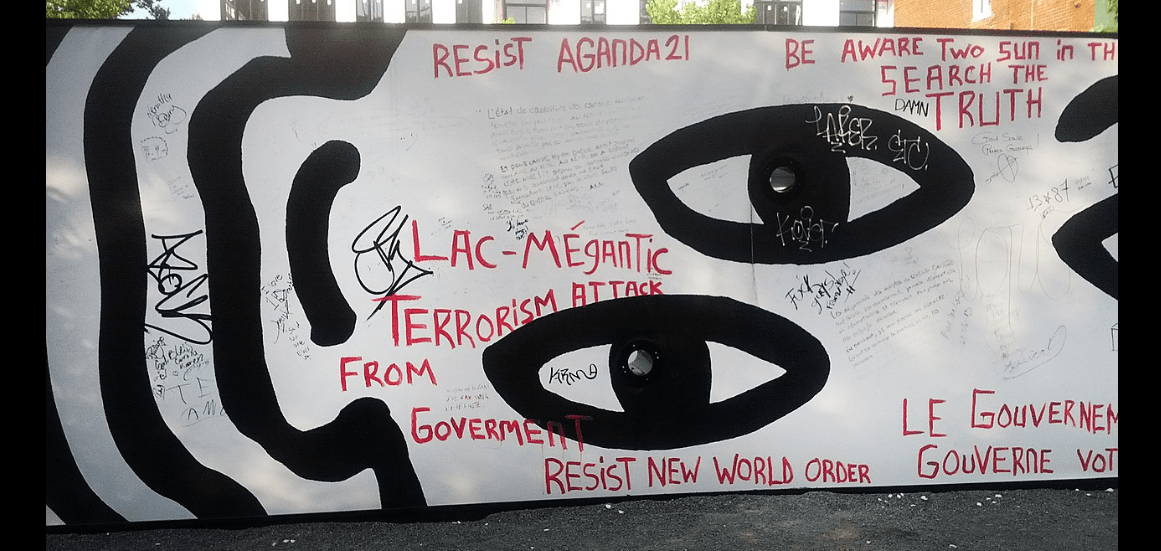
(Image from Wikimedia Commons: Conspiracy Theories Galore, Montreal)
 Anaemic On A Bike