To make the issue of in/visibility depend on physical appearance is to bracket out the historical realities of racist representation
“And that is the point. Visibility is socially constructed and can change over time. For example, Irish immigrants were singled out by the authorities as a specially ‘dangerous’ class in the 1850s, whereas in the 1950s their arrival was officially hardly noticed, despite the fact that they outnumbered immigrants from the New Commonwealth. This does not mean that prejudice against them had disappeared in the meantime. Paddy jokes had never been more popular than in the 1950s. Landladies hung up their ‘No Irish, No Coloureds, No Dogs’ signs without a second thought – all were equally undesirable. Indeed Blacks and Irish were interchangeable as animal categories of racial abuse. It is not so much through its exploitation of visible difference as in what it renders invisible or comparable that racist ideology produces its effects. […] in pursuit of natural symbolisms of inferiority, racist discourses have never confined themselves just to body images. Names and modes of addresses, states of mind and living conditions, clothes and customs, every kind of social behaviour and cultural practice have been pressed into the service to signify this or that racial essence. In selecting these materials, racist codes behave opportunistically according to an economy of means; they choose those signs which do the most ideological work in linking – and naturalising – difference and domination within a certain set of historical conditions of representation. To make the issues of in/visibility depend on physical appearance is to bracket out precisely these historical realities.” (Cohen, 1988: 14)
The wandering Jew as the vampire, the hidden hand and the parasite
“The figure of the wandering Jew, or the Jew as eternal migrant is one of the most powerful and enduring myths of anti-Semitism. It is linked to three refrains: first, the Jew as a kind of vampire, committing ritual murder on Christian children and consuming their blood during the Passover ceremony, in an obscene reversal of the Holy Communion rites; second, the Jew as a hidden hand secretly manipulating the course of history to visit death and destruction on the body politic; and third, the Jew as a parasite preying on the host society. These images, separately or together, have been used to justify all manner of attacks on Jewish communities in Europe. They relay a simple message: the Jews are a pariah race, and the Diaspora is their just and eternal punishment for their original and chronically repeated crime of Christ’s murder. The flight of Jewish populations from persecution is thus further used against them, as confirming their ‘nomadic’ status. Throughout the Middle Ages these images remained anchored within the discourse of biblical genealogy and its theodicy of Christian privilege. But, of course, the advent of capitalism posed a threat to the hegemony of the Church and threatened to destabilise many of its traditional forms. In this transitional period, anti-Judaism increasingly gave way to anti-Semitism proper; the three key images of the Jew were rearticulated within a new constellation of meaning; they now served as metaphors of the very economic changes which were disrupting the social and moral order on which the Church had come to depend. […] It is no surprise, then, to find the Jew associated with merchant capital, in its purely negative effect. The wandering Jew thus becomes a symbol of its free circulation, whose invisible and parasitic influence on traditional economic life find their perfect metaphor in the image of the vampire and the hidden hand. So whatever their actual occupations, Jews are made to practice a form of generic usury, either transgressing the moral economy of capital’s ‘just price’ or undermining that of labour. Equally, courtesy of anti-Semitism, Christianity is able to dissociate itself from the worst excesses of capitalism, whilst continuing to preach a work ethic which makes the profit motive a special calling, aspired to by all, but realised only by a chosen few. With the age of reason and enlightenment this thematic is transposed into the cultural sphere. Now the wandering Jew comes to represent the free circulation of ideas, whose bad side consists in threatening traditional orthodoxies of religious and political belief. The Jew becomes a symbol of the alienation and rootlessness of the modern intellectual, and this in turn is used to justify his continued exclusion from the professions and from academic life. Moreover, as soon as wandering Jews begin to put down roots they become even more dangerous; like the creepers which have been named after them they are supposed to spread into every nook and cranny of England’s ‘green and pleasant land’. Now it is the very tenaciousness of Jewish culture which is the threat. Finally, in the global conspiracy theories of modern anti-Semitism, the economic and ideological dimensions are brought together: the Jew is portrayed as a cut-throat capitalist bleeding the workers to death and as a free-thinking socialist poisoning the hearts and minds of Young England.” (Cohen, 1988: 16-17)
Dirty money allied to dirty sex
“We suggested that in the eighteenth century, Jews could not be made the guiding hand behind the African slave trade, because the English plantocracy claimed that role quite openly and proudly themselves. It was not until the 1880s, with the advent of an enlarged Jewish presence, that the Jewish name could be ‘blackened’, in another way, by associating it with a white slave trade. One of the main complaints of Victorian anti-Semitism was that Jews were kidnapping young Christian girls and selling them into prostitution in the brothels of various ‘heathen’ countries. The precise location was always a matter of speculation – the Middle East, Latin America, and so on, but this was less important than the image of the English maiden forced to satisfy the ‘lusts of Babylon’ to make Jewish fortunes. More recently a reverse theme has been added – the Jew as the hidden hand behind the Black immigration from the colonies. Whether as exporter of English girls or importer of Black men, the Jew is made to play his traditional role as a merchant in flesh, yet in such a way as to reinforce negative stereotypes of Black sexuality: dirty money allied to dirty sex. In this way the Jew is associated with a black market, and the link between the immigrant and the criminal hardens into its familiar, and all too contemporary, shape.” (Cohen, 1988: 22)
‘Race’ as the abstract expression of an eternal trans-historical identity
“For where ethnicity is conflated with race, it tends to be reified into a set of essential defining traits – Jewishness, Irishness, Blackness, for example – so that they cease to be part of a concrete historical process and become instead the abstract expression of an eternal trans-historical identity.” (Cohen, 1988: 24)
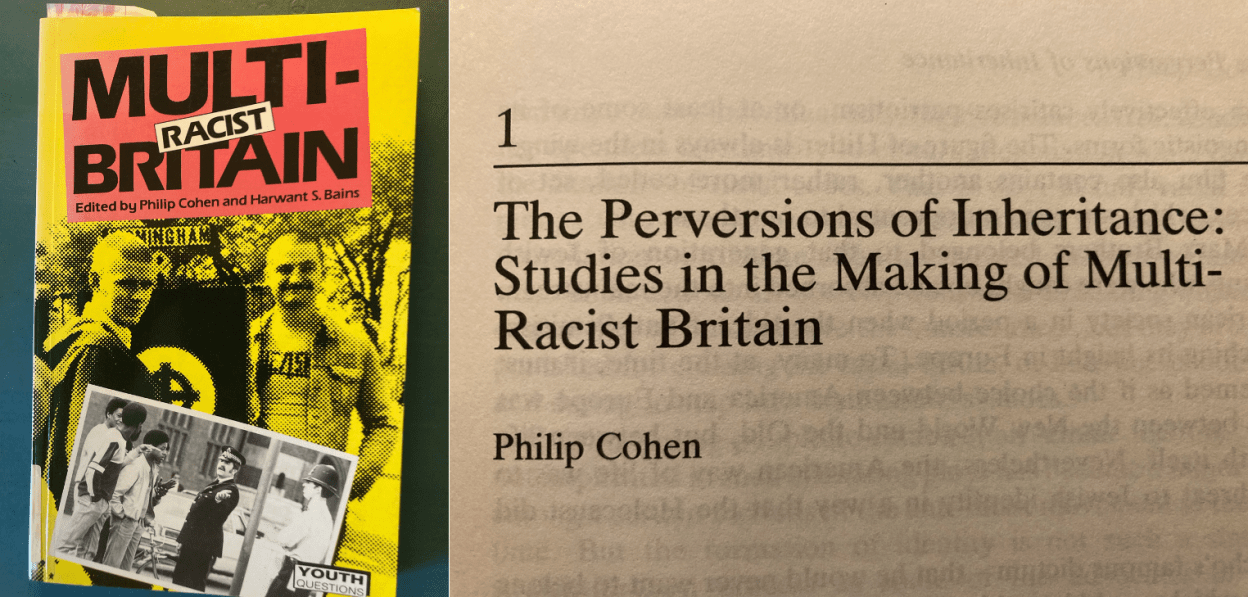
Cohen, Philip and Harwant S. Bains (editors) (1988) Multi-Racist Britain. MacMillan Education, Hampshire and London.
 Anaemic On A Bike